
Voliro T – ultrasonic inspection drone for testing from the air
Access to hard-to-reach structures without scaffolding, rope access or lifts. The Voliro T aerial robot presses an ultrasonic probe against the surface in any orientation and measures wall thickness with a live A-scan.
Why a contact-inspection drone?
Ultrasonic thickness measurement requires the probe to touch the surface with a stable force – something conventional drones cannot do. The Voliro T is an omnidirectional tilt-rotor platform: it can hold its position against vertical walls, inclined surfaces and the underside of structures and apply a controlled contact force to the probe.
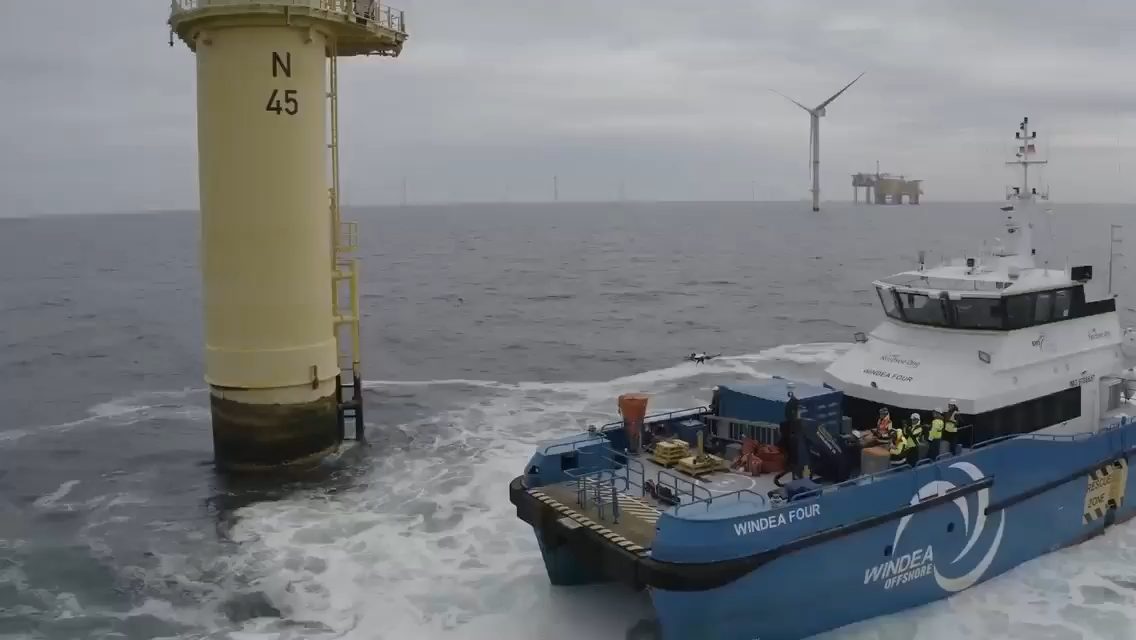
This makes it possible to measure wall thickness and corrosion on storage tanks, silos, pressure vessels, pipelines, chimneys, wind turbine towers and offshore structures while reducing the time, cost and risk of work at height.
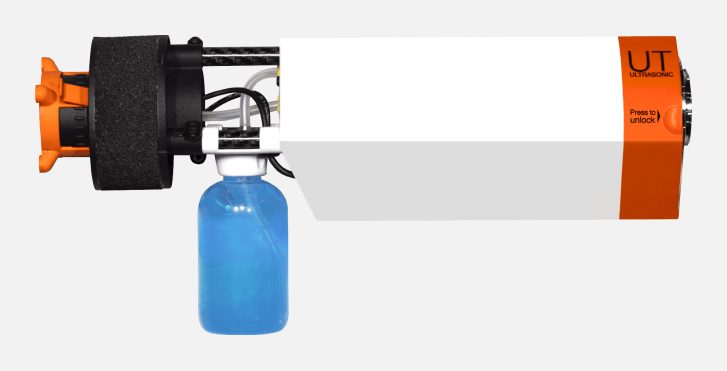
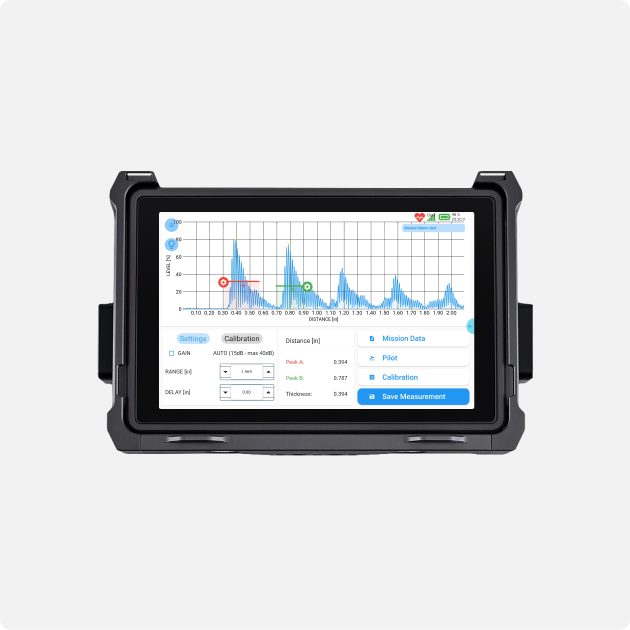
UT payload – ultrasonic thickness gauge
- Transducer compliant with EN 12668-1 and ISO 16831:2012
- Echo–echo and pulse–echo modes with live A-scan
- Thickness range: 4–150 mm
- Time resolution 0.02 µs – 0.06 mm at 5900 m/s
- Contact probe with controlled contact force (approx. 30 N)
- Couplant dispensed from the payload reservoir
Other NDT payloads
- EMAT thickness gauge – wall thickness without couplant
- Dry film thickness (DFT) of protective coatings
- High-temperature UT for hot surfaces in operation
- Two 4K cameras and a depth camera for visual inspection and positioning
Typical applications
- Storage tanks and silos
- Pressure vessels and process columns
- Pipelines and pipe racks
- Chimneys and stacks
- Wind turbine towers and offshore foundations
- Bridges, steel and concrete structures
Platform
- Omnidirectional tilt-rotor tricopter
- Weight incl. batteries: 3.7 kg
- Max. take-off weight: 6.0 kg
- Max. payload: 1.0 kg
Voliro and Voliro T are trademarks of Voliro AG (Switzerland). Product information and images published with the permission of Voliro AG.
Need a solution for a specific measurement problem?
OPTEL can evaluate the measurement physics, transducers, electronics and software before a full system is built.
Start with a feasibility studyContact OPTEL